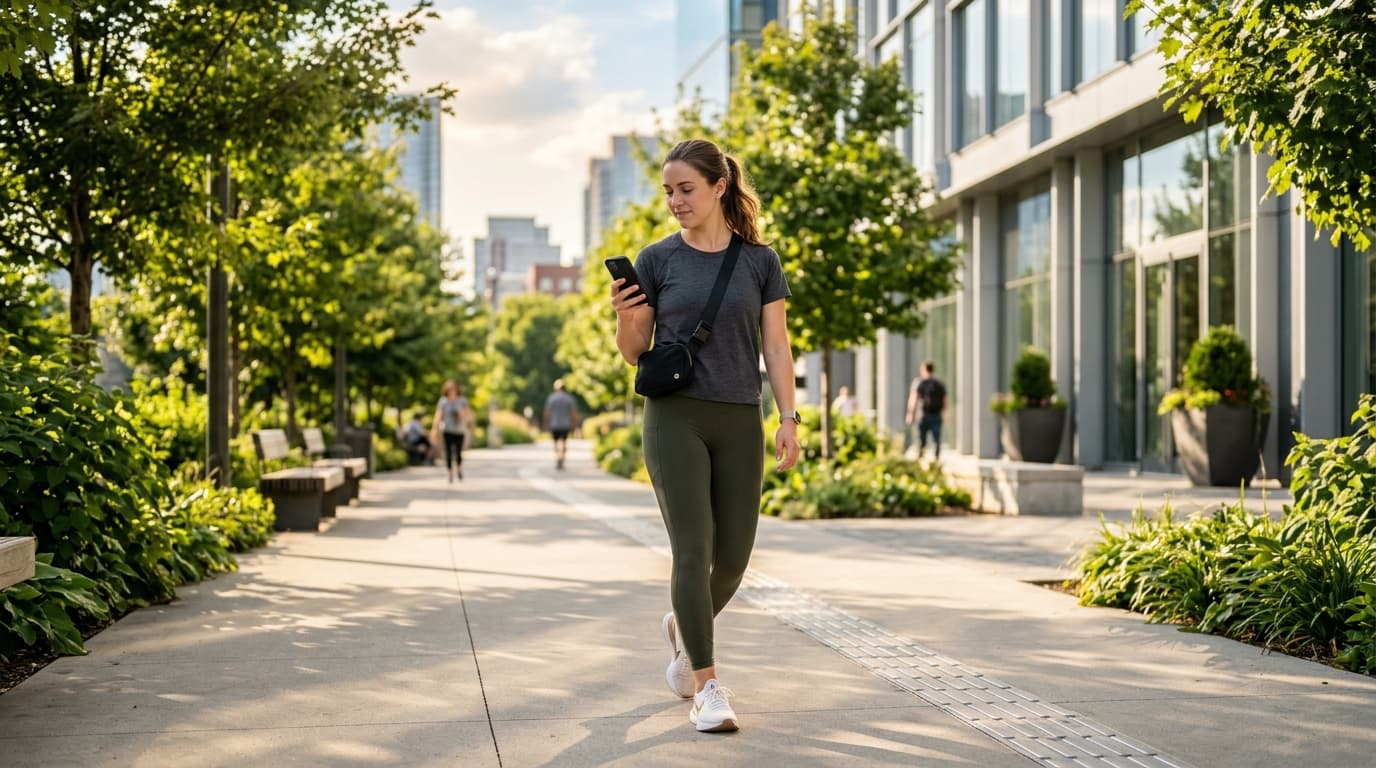
You glance at your Lock Screen at 3 PM and it says 4,100 steps. Your goal is 8,000. Are you on track?
Most people cannot answer that, and the reason is not arithmetic. A step count is a running total, not a forecast. The same 4,100 means "comfortably ahead" for someone whose evening includes walking the dog, and "already lost" for someone whose day ends at a desk followed by the sofa. The raw number only becomes useful once you compare it against where your days usually stand at 3 PM.
This guide walks through how to turn a mid-afternoon count into a clear, reliable answer — by hand in about thirty seconds, or automatically — while there are still enough daylight hours left to do something about it.
Quick Answer: How to Know If You Will Hit Your Step Goal
- Do not divide your goal by 24 hours. Daily activity is clustered, not evenly spread across every waking hour.
- Check your step count between 2:00 PM and 4:00 PM. Compare your current count against your own historical weekday average at that exact same time on days you hit your target.
- Calculate your deficit in walking minutes. Use the rule of thumb: 1,000 steps ≈ 10 minutes of brisk walking (~100 steps/min). If you are 2,000 steps short of your benchmark, you need a 20-minute walk before dinner.
Table of contents
- Why "half the day, half the goal" gets it wrong
- The 30-second pace check formula
- Hourly step milestones: noon, 3 PM, and 6 PM
- Steps-to-minutes walking conversion table
- Pick a checkpoint time — and stick to it
- 4 practical ways to catch up on steps before bed
- When "no" is the right answer
- Letting the app do the forecast
- Frequently asked questions
- Key takeaways
Why "half the day, half the goal" gets it wrong
The intuitive method is linear: if it is halfway through your waking day and you are halfway to your goal, you assume you are on track. It is simple, intuitive, and wrong more often than it is right.
Real days are lumpy. Steps cluster around a commute, a lunch break, school pick-up, an evening loop, or errands after work — and those clusters sit at different hours for different lifestyles:
- The transit commuter front-loads their morning with 3,000 steps to the train, sits still until 5:30 PM, and adds another 3,000 on the return leg. Linear pacing makes them look behind at 3 PM even though their largest walking block is still ahead.
- The desk worker / remote professional may log barely 1,200 steps by noon. If they try to pace linearly, they assume the day is hopeless by 2 PM and abandon the goal entirely.
- The midday walker might hit 5,000 steps by 1 PM after a lunchtime errand, believe they are comfortably cruising, and then discover at 9 PM that their evening had zero natural movement in it.
What predicts your finish line is never an even clock-based average. It is the specific hourly distribution shape of your own routine.
The 30-second pace check formula
You can calculate an accurate pace check yourself in less than half a minute. You only need three numbers:
Here is how to run the check step by step:
1. Find your typical count at the checkpoint hour
Open your Apple Health or fitness history and look at five recent weekdays when you successfully closed your step goal. Roughly how many steps did you have logged by 3 PM? That is your checkpoint benchmark.
You only need to calculate this baseline once, revising it only when your schedule fundamentally changes. Most people discover their benchmark is noticeably lower than 50% of their goal because a substantial volume arrives after 5 PM.
2. Compare today against your benchmark
- At or above your checkpoint: You are on track. Follow your standard evening routine and you will close the goal naturally.
- 300 to 800 steps below: You are on the bubble. One minor adjustment — taking the stairs, walking to get coffee, or a ten-minute errand — closes the gap.
- 1,500+ steps below: Today will not close on autopilot. You need a dedicated walk or active break before sitting down for the night.
3. Convert the gap into walking minutes
Steps are abstract; minutes are concrete blocks you can schedule on a calendar. Controlled research on walking cadence published in CADENCE-adults establishes that a moderate-to-brisk walking pace is approximately 100 steps per minute (roughly 2.7 to 3.0 mph) for healthy adults.1 A casual, relaxed stroll averages around 80 steps per minute, while purposeful brisk walking or incline walking reaches 115–120 steps per minute.
A worked example
- Daily Goal: 8,000 steps
- Your typical 3 PM count on winning days: 3,800 steps
- Your typical evening routine (post-work commute, cooking, dinner stroll): Adds ~3,500 steps
- Today's count at 3 PM: 2,400 steps
The math:
At a brisk pace of 100 steps per minute, .
Knowing you need "2,100 steps" feels vague and discouraging. Knowing that a 20-minute post-work walk around the block guarantees a completed goal turns an abstract deficit into a concrete plan.
Hourly step milestones: noon, 3 PM, and 6 PM
To help you gauge your pace immediately, the table below outlines typical progress milestones across three common work styles for both an 8,000-step goal and a 10,000-step goal:
| Schedule Archetype | Noon (12 PM) | Mid-Afternoon (3 PM) | Evening (6 PM) | Typical Evening Steps Added |
|---|---|---|---|---|
| Desk Worker / Hybrid (Steps back-loaded after work) | • 8k: 1,500–2,200<br>• 10k: 2,000–2,800 | • 8k: 2,800–3,800<br>• 10k: 3,500–4,800 | • 8k: 4,800–5,800<br>• 10k: 6,000–7,200 | 2,500 – 3,500 steps (Requires intentional evening walk) |
| Active Commuter (Steps front-loaded & transit-focused) | • 8k: 3,200–4,000<br>• 10k: 4,000–5,200 | • 8k: 4,200–5,200<br>• 10k: 5,500–6,800 | • 8k: 6,800–7,600<br>• 10k: 8,200–9,200 | 1,500 – 2,200 steps (Closes on return commute) |
| Morning Exerciser / Dog Walker (Heavy early start) | • 8k: 4,500–5,500<br>• 10k: 5,500–7,000 | • 8k: 5,800–6,800<br>• 10k: 7,200–8,400 | • 8k: 7,200–8,000<br>• 10k: 8,800–9,800 | 1,000 – 1,500 steps (Casual household movement) |
If your count falls below the low end of your bracket at 3 PM, that is your early signal that today requires intentional action before dinner.
Steps-to-minutes walking conversion table
When you know how many steps you are trailing, use this conversion chart to plan your catch-up walk:
| Steps Short | Brisk Walk (~100 steps/min) | Casual Stroll (~80 steps/min) | Approx Distance (Miles) | Approx Distance (Km) |
|---|---|---|---|---|
| 500 steps | 5 min | 6–7 min | ~0.25 mi | ~0.4 km |
| 1,000 steps | 10 min | 12–13 min | ~0.50 mi | ~0.8 km |
| 1,500 steps | 15 min | 18–19 min | ~0.75 mi | ~1.2 km |
| 2,000 steps | 20 min | 25 min | ~1.00 mi | ~1.6 km |
| 3,000 steps | 30 min | 37–38 min | ~1.50 mi | ~2.4 km |
| 4,000 steps | 40 min | 50 min | ~2.00 mi | ~3.2 km |
| 5,000 steps | 50 min | 62–65 min | ~2.50 mi | ~4.0 km |
Note: Distance calculations assume an average stride length of roughly 2,000 to 2,200 steps per mile (approx. 1,300 steps per km).
Pick a checkpoint time — and stick to it
The timing of your pace check is just as critical as the calculation:
- Too early (before 11 AM): Too little of your day has unfolded. Almost everyone appears severely behind at 9:30 AM, triggering unnecessary frustration.
- Mid-afternoon (2:00 PM to 4:00 PM): This is the golden window. You have completed roughly 60–70% of your working hours, your natural daily trend is visible, and you still have enough daylight and energy to add a 15-to-30-minute walk.
- Late evening (after 8:30 PM): An 8:30 PM check is not a forecast; it is an autopsy. Discovering you need 3,500 steps right before bed forces you to choose between pacing your living room in your socks or going to bed feeling disappointed.
Make your checkpoint an anchor habit tied to an existing afternoon routine: pouring your 3 PM coffee, closing your laptop for your afternoon break, or glancing at your iPhone Lock Screen steps widget.
It also pays to account for daylight and seasonal shifts. In summer, an outdoor walk at 7:30 PM is pleasant; in December, it is pitch-black and freezing by 5 PM. When winter approaches, slide your checkpoint an hour earlier (between 1:30 PM and 2:30 PM) so you can catch up during remaining sunlight.
4 practical ways to catch up on steps before bed
If your mid-afternoon check reveals a 1,500-to-3,000 step deficit, you do not need to do an intense workout. Four simple strategies can comfortably absorb that deficit:
- The 15-minute post-dinner walk: Taking a brisk 15-minute walk immediately following your evening meal adds roughly 1,500 steps. Clinical research demonstrates that walking after meals is also significantly more effective for regulating postprandial blood sugar than a single walk earlier in the day.2
- The walking phone call or podcast loop: If you have an end-of-day check-in call, 1-on-1 meeting, or podcast you listen to, put on headphones and pace outdoors or around your office building. A 20-minute call easily logs 1,800–2,000 steps.
- Park further or disembark one stop earlier: If you commute, park at the far end of the transit station lot or exit one subway stop ahead. That single tweak adds an effortless 600–1,000 steps without disrupting your calendar.
- Active household transitions: Taking stairs instead of elevators, walking laps while waiting for water to boil or clothes to dry, and taking an intentional lap around the block before sitting down on the couch can add 500–800 steps in small bursts.
When "no" is the right answer
A reliable pace check is not a whip to force you into walking laps at midnight. Its real value is giving you clarity early enough to make an intentional choice.
If you are 4,500 steps short at 7:30 PM after a grueling 12-hour workday or cross-country flight, the realistic answer is that today will not close without sacrificing sleep or rest. Let it go.
Missing an occasional day has zero impact on your long-term cardiovascular health or longevity. A large 2025 meta-analysis published in The Lancet Public Health demonstrated that consistent weekly movement volume across time matters far more than an unbroken streak of arbitrary days.3 Obsessively pacing around a bedroom at 11 PM creates bedtime sleep disruption that undermines your recovery.
If you find yourself well below your benchmark four or five days every week, your pace is not the issue — your target is. See our guide on how to set a realistic daily step goal to dial in a target that matches your actual baseline.
Letting the app do the forecast
The manual 3-step check works, but it requires you to remember to look, pull up past days, and do mental arithmetic. A predictive app eliminates that friction by doing the math continuously in the background.
This predictive approach is the foundation of Steps Widget. Instead of sending generic reminders on a static timer, it projects the step count you are heading for by midnight and only notifies you when that projection falls short of your target.
- It learns your daily distribution, not a flat average. On initial launch, Steps Widget analyzes up to a full year of your personal Apple Health history. It learns whether your steps naturally occur during morning runs, lunch walks, or evening commutes. When your schedule changes, the model adapts.
- It projects from real data. The model calculates expected steps for your remaining waking hours and adds them to your actual live step count. It never forecasts below where you currently stand.
- It respects the actionable window. Smart goal notifications trigger during the productive afternoon and early evening hours, capped at at most once per hour, and only when you are genuinely projected to miss your goal. If you are on track, it stays completely silent.
- It translates steps into time. Alerts tell you both the steps you need and the time remaining — performing the steps-to-minutes calculation automatically.
- Local Sunset awareness. By enabling the Local Sunset option, the projection threshold adjusts as sunset approaches, nudging you earlier during darker winter months.
- Complete on-device privacy. No user accounts, cloud tracking, or external servers. All training and projections run on your iPhone within Apple Health's private sandbox.
Combine this with a Lock Screen step counter and you get a zero-friction system: glance down to see where you are, and let the forecast notify you only when you need to act. Read more in how goal reminders work.
Frequently asked questions
How many steps should I have by noon? There is no single universal number because daily routines differ. For desk workers aiming for 8,000 to 10,000 steps, having 1,500 to 2,500 steps by noon is typical, as a large share of activity happens during lunch or after work. For active morning commuters or runners, noon counts usually reach 4,000 to 6,000 steps.
How many steps should I have by 3 PM and 5 PM? By 3 PM, desk workers aiming for 8,000 steps typically have between 2,800 and 3,800 steps, while those with a 10,000-step goal usually have 3,500 to 4,800 steps. By 5 PM to 6 PM, you should ideally have roughly 60% to 75% of your goal completed (around 5,000 to 6,000 steps for an 8k goal; 6,500 to 7,500 for a 10k goal) before starting your evening routine.
How long does it take to walk 1,000, 2,000, or 3,000 steps? At a moderate-to-brisk walking cadence of 100 steps per minute, 1,000 steps takes approximately 10 minutes, 2,000 steps takes 20 minutes, and 3,000 steps takes 30 minutes. At a relaxed stroll (~80 steps/min), expect roughly 12 to 13 minutes per 1,000 steps.
Is it accurate to divide my daily step goal evenly by hour? No. Dividing your total goal evenly across waking hours assumes linear movement, which rarely matches real life. Steps naturally cluster around morning commutes, lunch breaks, and evening walks. Comparing your count against your own typical history at the same hour is far more predictive.
What is the best time of day to check if I will hit my step goal? Mid-afternoon, between 2:00 PM and 4:00 PM, is the ideal window. Earlier in the morning there is too little data on record; later in the evening (past 8:00 PM), closing a multi-thousand-step deficit requires an inconvenient late-night walk.
How can I catch up if I am 2,000 to 3,000 steps behind in the evening? The easiest way to close a 2,000-to-3,000 step deficit is a dedicated 20-to-30-minute brisk walk after dinner. Combining post-meal walking with active phone calls, taking the stairs, or parking further from stores absorbs the gap without formal workout gear.
How many steps per minute is considered a brisk walking pace? In exercise science, brisk walking cadence begins at roughly 100 steps per minute for healthy adults, corresponding to approximately 2.7 to 3.0 mph. Fast-paced walking or hill walking ranges from 115 to 125 steps per minute.
Can my iPhone or Apple Watch predict if I will hit my step goal? The native Apple Health and Fitness apps display your current cumulative count, but they do not provide predictive end-of-day forecasts. Third-party apps like Steps Widget train a machine learning model on your historical Apple Health data to forecast your end-of-day total and send smart reminders only when you are projected to fall short.
Key takeaways
| Question | The short answer |
|---|---|
| Can I just divide my goal across the day? | No — steps cluster around routines, making linear pacing misleading in both directions |
| What should I compare against? | Your own typical count at 3 PM on historical days you hit your goal |
| What is the steps-to-minutes walking ratio? | ~100 steps per minute at a brisk pace: 1,000 steps ≈ 10 minutes |
| When is the optimal checkpoint? | Mid-afternoon (2:00 PM – 4:00 PM); adjust earlier during short winter days |
| How do I catch up easily in the evening? | A 20-minute post-dinner walk (adds ~2,000 steps and improves glucose response) |
| What if the projected shortfall is too large? | Let the day go; if shortfalls happen most days, lower your baseline goal |
Related reading:
- You sit longer than you realize — why mid-afternoon awareness beats nightly guilt.
- How to set a realistic daily step goal — setting a target you can actually sustain.
- Pedometer app with move reminders — how activity-aware nudges prevent notification fatigue.
- iPhone Lock Screen steps widget — keeping your real-time count visible at every glance.
References
-
Tudor-Locke C, Aguiar EJ, Han H, et al. Walking cadence (steps/min) and intensity in 21–40 year olds: CADENCE-adults. International Journal of Behavioral Nutrition and Physical Activity. 2019;16:8. doi:10.1186/s12966-019-0769-6 ↩
-
Reynolds AN, Mann JI, Williams S, Venn BJ. Advice to walk after meals is more effective for improving postprandial glycaemia in type 2 diabetes than advice to walk at any time: a randomised crossover trial. Diabetologia. 2016;59(12):2572–2578. doi:10.1007/s00125-016-4085-2 ↩
-
Ding D, Nguyen B, Nau T, et al. Daily steps and health outcomes in adults: a systematic review and dose-response meta-analysis. The Lancet Public Health. 2025;10(8):e668–e681. doi:10.1016/S2468-2667(25)00164-1 ↩
Recommended posts
Try Steps Widget
Keep your daily steps visible on iPhone, Lock Screen, Home Screen, and Apple Watch with a private Apple Health step counter widget.